Bitter Coffee, Sweet Opportunity: Why Belize Must Move Swiftly While Honduras and Mexico Clash Over Trade
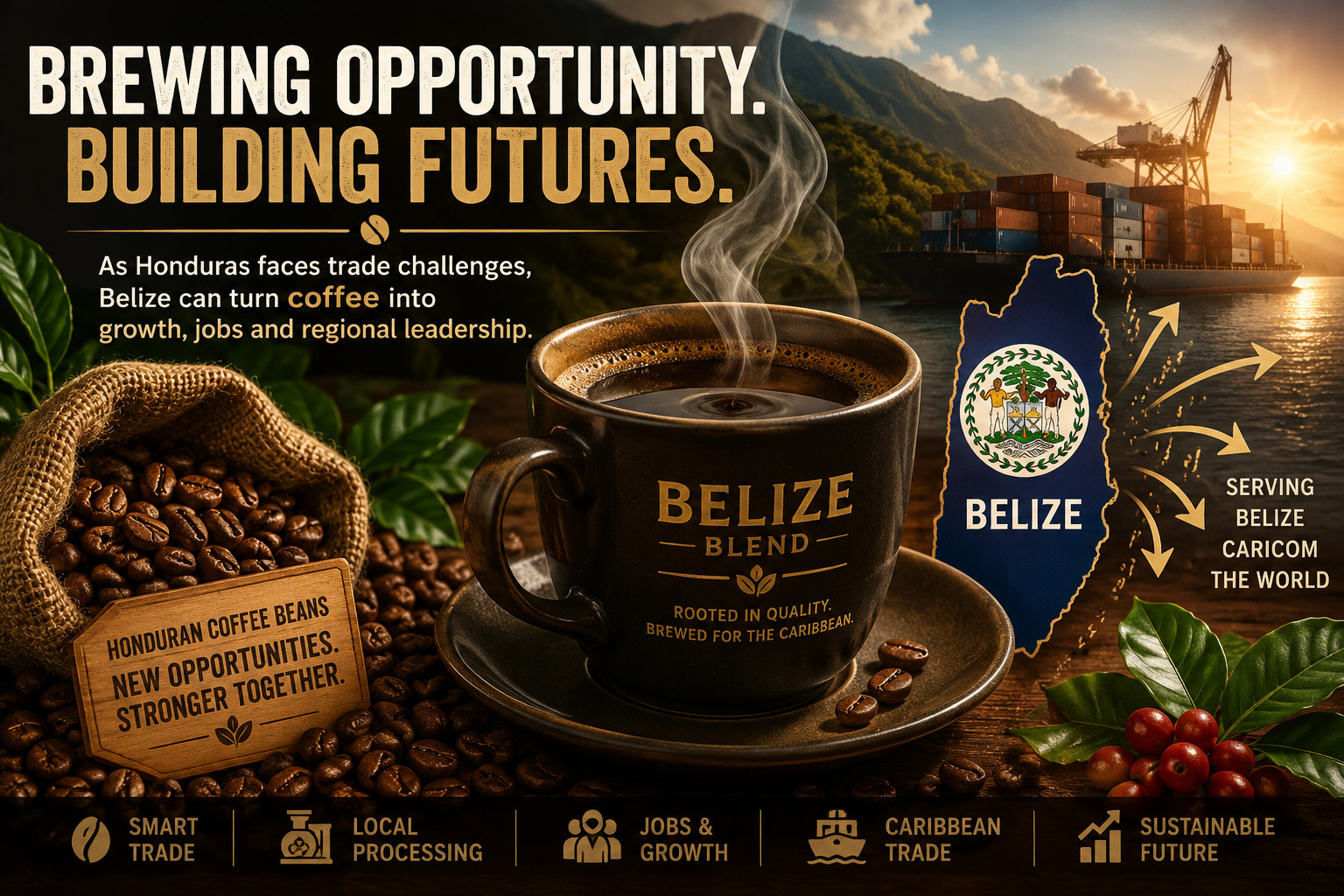
Why Belize Must Move Swiftly While Honduras and Mexico Clash Over Trade
By: Omar Silva – Editor/Publisher
National Perspective Belize – Digital
www.nationalperspectivebz.com
Belize City: Thursday 21st May 2026
When two larger economies enter a trade confrontation, smaller nations often stand at the sidelines watching the storm. But history has repeatedly shown that the countries that rise are not always the biggest; they are the ones agile enough to identify disruption and convert it into opportunity.
The ongoing trade friction between Honduras and Mexico over strategic exports such as coffee, shrimp, and palm oil may appear at first glance to be merely another regional trade dispute. Yet beneath the diplomatic language surrounding “dumping,” pricing irregularities, and unfair competition lies a rare opening for Belize to begin thinking strategically instead of reactively.
For decades Belize has operated as an import-dependent economy, consuming more than it transforms, purchasing more than it manufactures, and exporting largely raw or minimally processed goods. Meanwhile, neighboring Honduras remains one of Central America’s major coffee-producing nations, with established cultivation networks, experienced growers, and export-grade beans searching for markets during periods of instability and pricing pressure.
This moment presents Belize with something it rarely receives:
An opening to enter a value-added agro-processing sector without having to immediately shoulder the full burden of large-scale agricultural cultivation.
Why Honduras’ Crisis Could Become Belize’s Opening
If Mexican authorities continue tightening trade scrutiny against Honduran coffee under allegations of “dumping,” Honduran exporters may urgently seek alternative regional buyers capable of absorbing moderate volumes quickly and consistently.
Belize, despite its small size, possesses several strategic advantages:
• Geographic proximity to Honduras.
• Access to Caribbean trade channels through CARICOM.
• Existing port access and regional logistics.
• English-speaking market positioning.
• A growing tourism and hospitality sector demanding premium coffee products.
• An underdeveloped but highly expandable agro-processing environment.
Instead of seeing itself merely as a consumer market, Belize could become:
• A regional coffee refining and blending hub.
• A packaging and branding center.
• A distributor of Caribbean-targeted specialty coffee products.
• A future exporter of “Belize Blend” coffee lines.
This is where vision becomes essential.
Belize does not need to immediately compete against Brazil, Colombia, or even Honduras itself in raw production. Belize can instead compete in refinement, branding, niche marketing, Caribbean distribution, and premium packaging.
That is where smaller economies survive.
That is where value is created.
The Strategic Mechanism Belize Must Build
1. Immediate Bilateral Trade Engagement with Honduras
The Government of Belize, through the Ministries of Trade, Agriculture, and Foreign Affairs, should immediately begin exploratory bilateral discussions with Honduran coffee cooperatives and exporters.
The objective would not be massive imports overnight.
The smart strategy would involve:
• Pilot agreements.
• Moderate import quotas.
• Stable pricing structures.
• Long-term supply assurances.
• Preferential logistics arrangements.
Belize must move before larger regional players absorb these opportunities.
2. Establish a Small National Coffee Refining and Roasting Sector
Belize imports large quantities of finished coffee products annually. This means Belize already consumes coffee but exports the profits abroad.
Instead, Belize could:
• Import raw Honduran coffee beans.
• Roast locally.
• Blend locally.
• Package locally.
• Brand locally.
• Distribute locally and regionally.
Even a modest refining facility could create:
• Employment.
• Packaging industries.
• Graphic design opportunities.
• Logistics jobs.
• Agricultural research opportunities.
• Export potential.
A “Made in Belize” coffee line using regional beans refined locally could become viable across:
• Belize.
• The tourism sector.
• CARICOM niche markets.
• Cruise tourism retail outlets.
• Duty-free and airport commerce.
3. Create a “Belize Blend” Identity
This is where intelligence matters.
Belize should not simply resell Honduran coffee.
Belize must create identity.
Possible concepts:
• Belize Mountain Blend.
• Maya Highlands Reserve.
• Caribbean Sunrise Coffee.
• Belize Rainforest Roast.
Belize’s tourism image already sells nature, rainforest, authenticity, and culture. Coffee branding can integrate directly into that narrative.
This is precisely how smaller economies create premium markets.
4. Develop Strategic CARICOM Distribution
Many smaller Caribbean nations:
• Lack refining capacity.
• Import expensive finished coffee brands.
• Depend heavily on external suppliers.
Belize could position itself as:
• A regional medium-scale supplier.
• A Caribbean-focused boutique coffee processor.
• A lower-cost regional alternative.
This would require:
• Trade facilitation.
• CARICOM standards certification.
• Food safety modernization.
• Export financing mechanisms.
5. Use the Development Finance Corporation (DFC) Correctly
Instead of politically convenient lending, Belize’s financing institutions should support:
• Small coffee roasting businesses.
• Packaging facilities.
• Warehousing.
• Agro-processing startups.
• Cooperative entrepreneurship.
Without affordable financing, the opportunity dies before birth.
6. Build Public-Private Partnerships
Government alone cannot build industries.
Belize should encourage:
• Belizean entrepreneurs.
• Supermarket chains.
• Tourism operators.
• Farmers’ cooperatives.
• Diaspora investors.
• Small manufacturers.
This sector must be entrepreneurial, not bureaucratic.
7. Long-Term Vision: Belizean Coffee Cultivation
While Belize may not yet be a major coffee producer, climate conditions in some upland areas may support selective cultivation experimentation.
This should begin with:
• Agricultural feasibility studies.
• Pilot farms.
• Climate resilience testing.
• Regional technical cooperation with Honduran experts.
Belize must think 10–20 years ahead, not election-cycle to election-cycle.
Why Timing Matters
Trade disruptions create temporary windows.
If Belize waits:
• Larger buyers will move first.
• Honduras will redirect supply elsewhere.
• Caribbean opportunities will close.
• The same old import dependency will continue.
This is why visionary governments move during instability, not after stability returns.
The Deeper National Lesson
The real issue extends beyond coffee.
The Honduras-Mexico dispute exposes something larger:
Belize has spent decades functioning as a passive economy instead of a strategic economy.
We wait for foreign investment.
We wait for grants.
We wait for loans.
We wait for instructions.
We wait for crises.
But successful nations identify fractures in regional trade and insert themselves intelligently into the gaps.
Coffee may seem small.
But industries are rarely born gigantic.
They begin with:
• One refining facility.
• One export agreement.
• One processing plant.
• One bold national decision.
The difference between stagnant economies and transforming economies is often the willingness to act before everyone else recognizes the opportunity.
- Log in to post comments