📰 When Power Questions Accountability: The Prime Minister vs. the Ombudsman
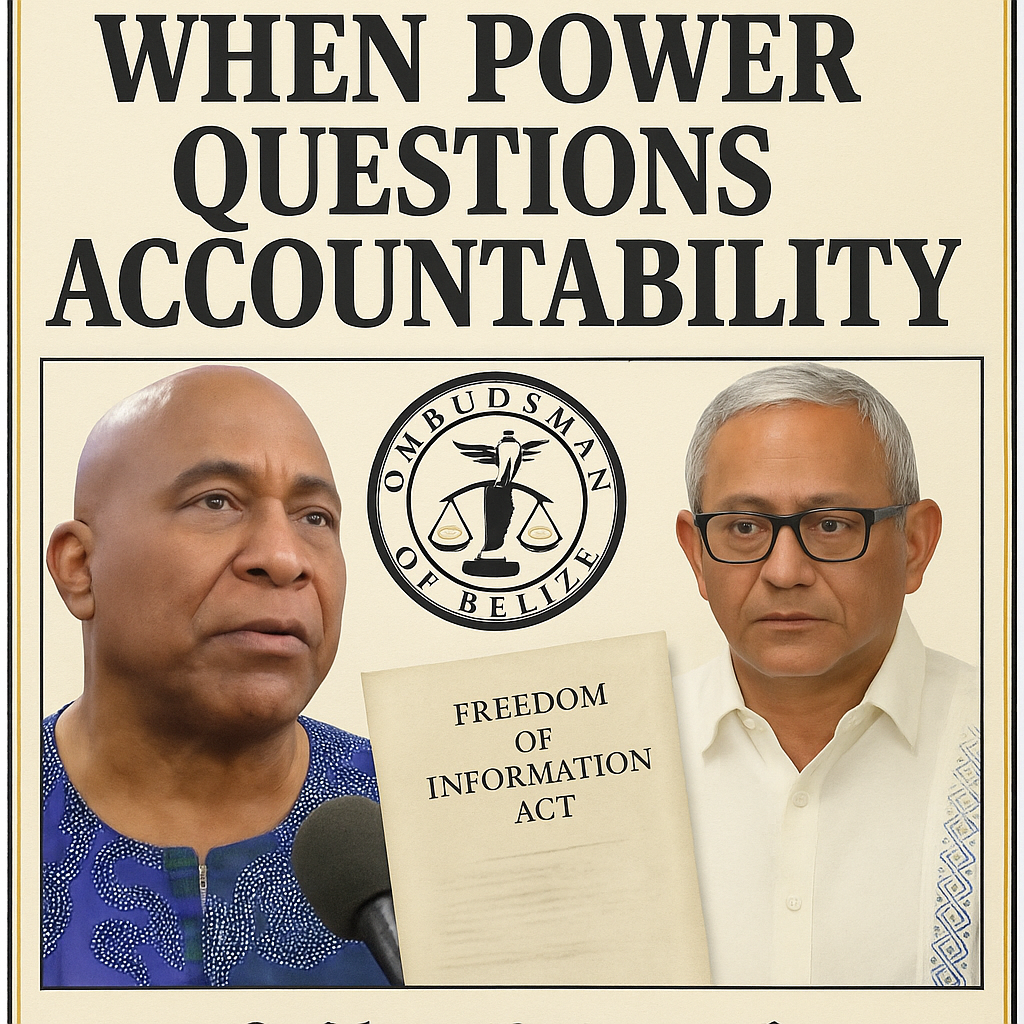
By: Omar Silva I Editor/Publisher
National Perspective Belize Editorial Team
A Government Offended by Oversight
In a democracy, the balance between power and accountability defines the health of the state. Yet, recent remarks by Prime Minister John Briceño, dismissing the authority of Belize’s Ombudsman to direct the Attorney General under the Freedom of Information Act (FOIA), betray a profound misunderstanding of constitutional governance—and an alarming contempt for the rule of law.
The Prime Minister’s suggestion that the Ombudsman has no authority to issue directives to the Attorney General, in a matter involving public access to government legal expenditure, is not just legally baseless—it is an affront to every principle of democratic oversight and institutional independence.
The Ombudsman’s Authority: Rooted in Law, Not Politics
Under Section 12 of the Ombudsman Act (Chapter 5:19), the Ombudsman is empowered to investigate any action, decision, or omission by a public authority where injustice or abuse of power may have occurred. This includes failures to comply with statutory obligations such as those under the Freedom of Information Act (Chapter 13:01).
The FOIA guarantees citizens the right to obtain public information—not as a courtesy, but as a constitutional entitlement flowing from the freedom of expression provisions in Section 12 of the Belize Constitution.
Therefore, when the Ombudsman directed the Attorney General’s Ministry to release information to activist Jerry Enriquez about the cost of the government’s legal battles in the Elections and Boundaries pre-election challenge, he was doing precisely what his office was created to do: defend transparency, uphold accountability, and protect the citizen’s right to know.
For the Prime Minister to publicly question this authority is to question the very concept of checks and balances that underpin Belize’s democracy.
An Administration Inflated by Power
Since 2020, Prime Minister Briceño and his inner circle have consolidated control over virtually every lever of state power. The Cabinet moves in unison, the Senate functions as an echo chamber, and oversight bodies—from the Public Accounts Committee to the Integrity Commission—have been rendered politically ornamental.
Even the Judiciary, which once stood as the final bulwark of constitutional independence, has not been spared political pressure. The Briceño administration’s actions—whether through delayed appointments, selective funding, or public remarks undermining judicial integrity—reflect a pattern of executive dominance that weakens every institution designed to hold it accountable.
The Prime Minister’s words about the Ombudsman fit neatly within this pattern. It is a symptom of inflated political ego—a belief that the executive, by virtue of electoral mandate, is above the very laws it is sworn to uphold.
Regional Standards Belize Has Ignored
Across the Caribbean and Central America, Ombudsman institutions serve as the moral and legal conscience of the state. In countries such as:
- Costa Rica, the Defensoría de los Habitantes compels ministries to release information on public contracts;
- Barbados and Jamaica, Ombudsmen report directly to Parliament and can trigger public censure when ministers defy the law;
- Honduras and Panama, the Ombudsman (Comisionado de Derechos Humanos) operates as a national human rights protector with investigative powers akin to those of a court-appointed authority.
Belize’s Ombudsman carries the same responsibility—to ensure that human rights, liberty, and administrative justice are preserved without fear or favour. When the head of government belittles that role, Belize isolates itself from regional norms of democratic accountability.
A Distasteful Arrogance: When the State Becomes Self-Serving
The Prime Minister’s posture toward the Ombudsman is not an isolated act of ignorance—it is a manifestation of political arrogance that has characterized this administration since its first year in office.
Behind the smiling populism lies a ruling clique intolerant of criticism, dismissive of dissent, and allergic to scrutiny. Ministers and senators alike appear bound by a shared loyalty not to the people of Belize, but to the centralized authority of the Prime Minister’s office.
Such concentration of power corrodes democracy. It turns institutions of justice into instruments of political convenience, reduces the Judiciary to a whisper, and turns laws into tools of selective application.
The Freedom of Information Act: A Right, Not a Request
The Freedom of Information Act was enacted to dismantle the culture of secrecy that breeds corruption. It compels transparency—especially regarding public contracts, government legal fees, and spending on politically sensitive cases.
When the Attorney General’s Ministry refuses to comply with legitimate FOIA requests, and the Prime Minister defends that refusal by questioning the Ombudsman, the message to Belizeans is chilling:
[ “Your right to know exists only when it suits us.” ]
This attitude not only violates the law—it undermines public trust, the cornerstone of democratic legitimacy.
The Larger Threat: Executive Impunity
The Ombudsman’s confrontation with the executive branch exposes the deeper ailment afflicting Belize: executive impunity masked as governance.
The Prime Minister’s dismissal of accountability mechanisms—from the Ombudsman to the unions and the media—illustrates a governing philosophy rooted in control, not service. The law becomes an obstacle, not a guide; institutions are subdued, not strengthened.
It is this erosion of institutional respect that invites international concern, damages Belize’s democratic image, and risks alienating the very citizens whose rights these laws were written to protect.
SIDEBAR BOX — THE OMBUDSMAN’S CONSTITUTIONAL ROLE
Mandate:
To investigate complaints of injustice, maladministration, or abuse of authority in public institutions.
Legal Basis:
- The Ombudsman Act, Chapter 5:19
- The Freedom of Information Act, Chapter 13:01
- Section 12, Belize Constitution (Freedom of Expression & Access to Information)
Powers:
- May summon witnesses and demand documents.
- May recommend corrective actions to ministries or departments.
- May report to the National Assembly when its recommendations are ignored.
Regional Equivalent:
Known as Defensor del Pueblo (People’s Defender) across Latin America and Public Protector in the Caribbean.
Editorial Kicker: The Measure of a Democracy
The measure of a democracy is not in how loudly its leaders speak, but how humbly they listen to the institutions that restrain them.
When a Prime Minister dismisses the Ombudsman for doing his job, it is not the Ombudsman who oversteps—it is the Prime Minister who forgets his place.
Belize deserves leadership that respects law above loyalty, truth above politics, and citizens above Cabinet.
- Log in to post comments