Sargassum Is Not the Problem — Our Failure to Innovate Is
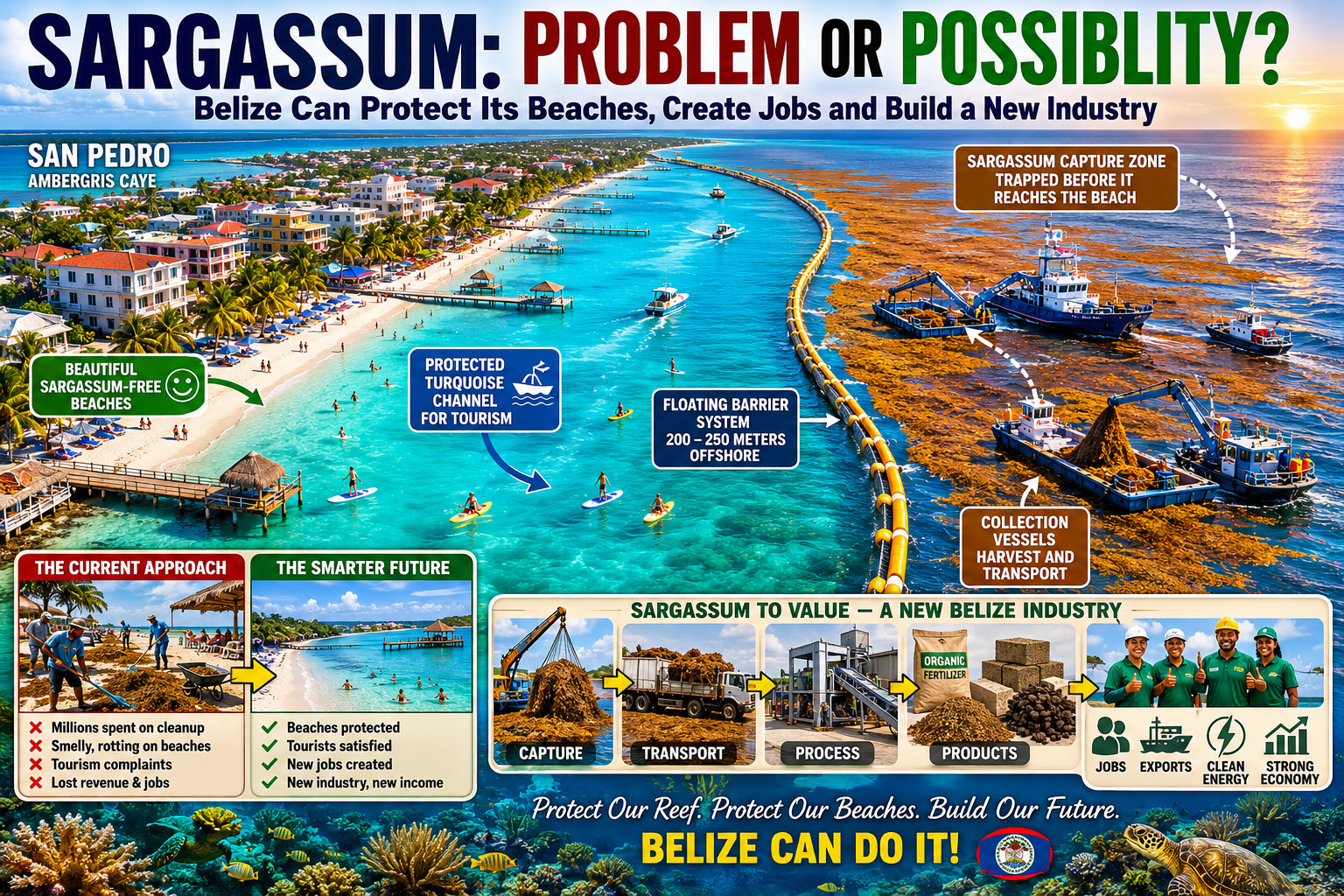
Belize City: Friday 29th May 2026 : For more than a decade Belize has been fighting a losing battle against sargassum.
Every year the same headlines appear.
The seaweed arrives.
The beaches turn brown.
The smell spreads.
Hotels spend thousands.
Town councils spend millions.
Government officials hold meetings.
Task forces are formed.
Funding is discussed.
And then the cycle repeats itself.
Yet after all these years, Belize continues to treat sargassum as if it were a natural disaster instead of recognizing it for what it has become:
A permanent feature of the Caribbean Sea and a potential economic resource.
While Belize debates whether enough money exists to clean beaches, other countries are investing in offshore collection systems, floating barriers, processing facilities, renewable energy projects, agricultural applications, and new industries built around the very same seaweed that Belize still considers a nuisance.
The difference is not the seaweed.
The difference is vision.
A Message to Belize's Politicians
The role of leadership is not simply to react to problems.
The role of leadership is to see opportunities before everyone else does.
The annual arrival of sargassum should no longer be viewed as a tourism problem.
It should be viewed as:
- an infrastructure challenge,
- an environmental challenge,
- an economic challenge,
- and potentially an industrial opportunity.
The same creativity used to build roads, airports, marinas, cruise ports, and tourism facilities can be applied to protecting Belize's coastlines.
Belize possesses one of the most valuable tourism assets in the Western Hemisphere:
Belize Barrier Reef Reserve System
Protecting that asset requires long-term thinking, not annual emergency spending.
A Message to Resort Owners And Investors
The future of Belize tourism is not under threat because of sargassum.
The future is threatened only if Belize refuses to adapt.
Tourism markets around the world have overcome far greater challenges.
Countries have adapted to hurricanes.
Countries have adapted to droughts.
Countries have adapted to coastal erosion.
Countries have adapted to climate change.
Belize can adapt to sargassum.
The beauty that draws visitors here remains unchanged.
The reef still exists.
The islands still exist.
The marine life still exists.
The culture still exists.
The hospitality still exists.
The sunsets still exist.
Sargassum is a management issue.
It is not the end of Belize tourism.
What Belize Could Become
Imagine a different future.
Instead of spending millions every year collecting seaweed from beaches, Belize develops:
- Offshore interception systems.
- Floating collection barriers.
- Marine harvesting operations.
- Processing facilities in San Pedro and Placencia.
- Fertilizer manufacturing.
- Biomass energy production.
- Sustainable construction materials.
Suddenly:
- New jobs emerge.
- New exports emerge.
- New investments emerge.
- New industries emerge.
What today washes ashore as waste becomes tomorrow's economic opportunity.
Why Tourists Should Continue Choosing Belize
Tourists should understand an important reality.
The images often shown on social media represent temporary periods and localized conditions.
Belize offers:
- hundreds of miles of coastline,
- numerous cayes,
- world-class diving,
- fishing,
- sailing,
- eco-tourism,
- jungle adventures,
- Maya archaeological sites,
- wildlife experiences.
A vacation in Belize is far more than a single stretch of beach.
Millions of visitors continue to choose destinations throughout the Caribbean that experience periodic sargassum events.
Belize remains one of the most unique tourism destinations in the region.
The National Challenge Before Us
The question facing Belize is no longer:
"How do we clean up sargassum?"
The real question is:
"How do we transform a recurring environmental challenge into a national opportunity?"
That is the conversation Belize should be having.
That is the vision investors want to hear.
That is the confidence tourists want to see.
And that is the type of leadership the country deserves.
Because nations do not advance by endlessly fighting yesterday's problems.
They advance when they have the courage to build tomorrow's solutions.
By: Omar Silva – Editor/Publisher
National Perspective Belize – Digital
- Log in to post comments